
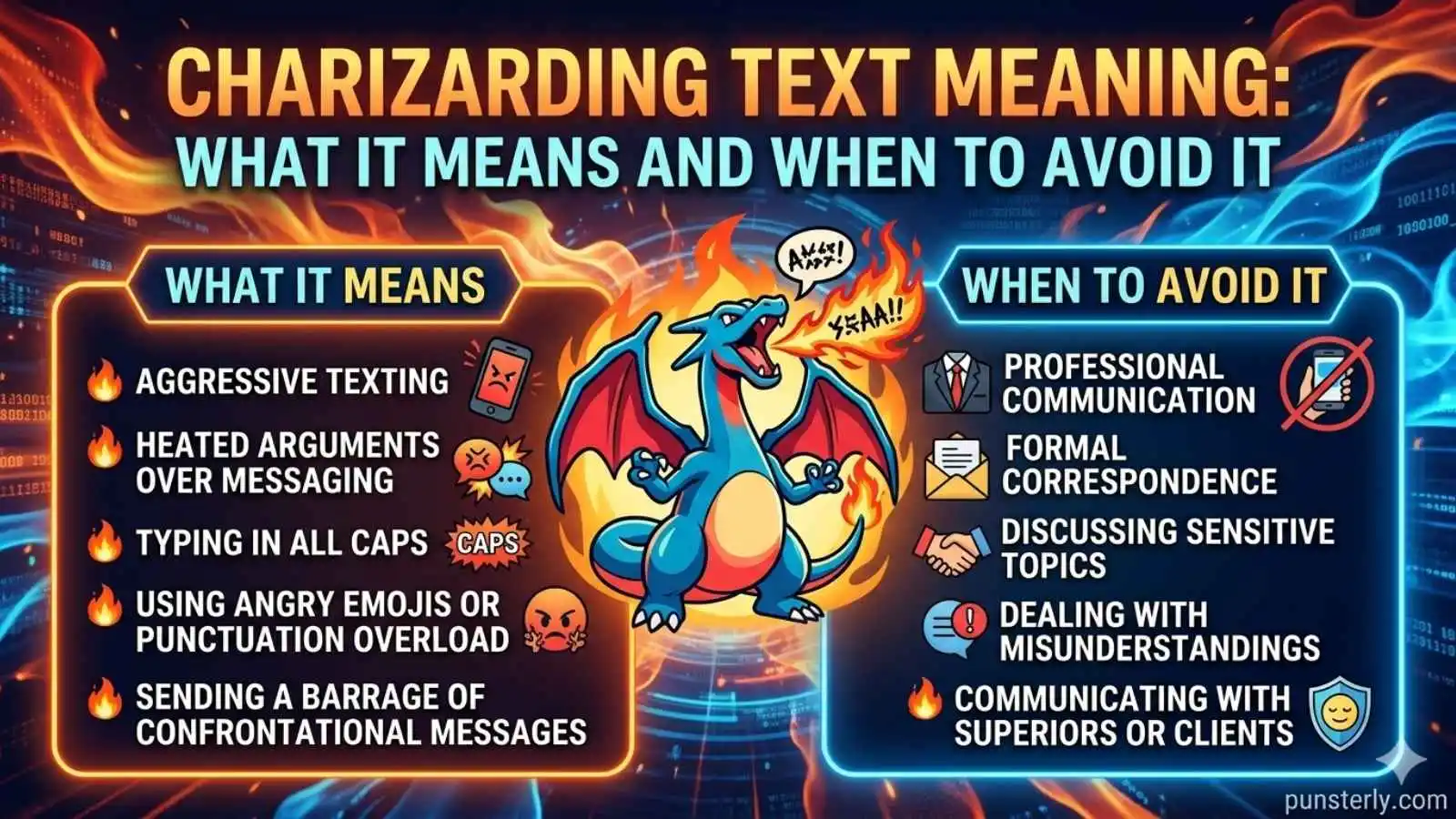
You may see charizarding in a text, meme, comment, or group chat. At first, it can look like a normal slang word. It sounds playful, and it clearly points to Charizard from Pokémon.
But this term is tricky. In many spaces, it carries a crude joke meaning. In other spaces, people use it more loosely for dramatic or over-the-top behavior. That split can cause confusion fast.
This guide explains what charizarding means in plain English. It also shows how people use it, why the meaning can change, when to avoid it, and what to say instead. If you saw the word online and felt unsure, this will help you read it more clearly.
Quick Answer
charizarding text meaning usually points to a niche slang term with a crude joke meaning. Some people also use it more loosely to mean acting dramatic, fiery, or extra, but that softer use is less reliable.
TL;DR
• It is niche internet slang.
• The older meaning is crude.
• Some people use it as “being extra.”
• It is not safe for formal settings.
• Context matters more than the word alone.
• Safer alternatives are usually better.
What Does “Charizarding” Mean?
The word has two meanings online. One is older and much rougher. The other is newer and softer.
In its more established slang use, charizarding refers to a graphic joke. Because of that, many readers will treat it as rude or not safe for work.
In a softer modern use, some people say charizarding when someone is:
• acting dramatic
• showing off
• overreacting
• bringing loud, fiery energy
That second use exists, but it is less stable. Many people still hear the rude meaning first.
Definition in Plain English
In plain English, charizarding is a niche online slang word. It is not standard everyday English.
The safest simple definition is this: it is a risky slang term that may mean a crude joke, or less often, acting overly dramatic. If you are not sure which meaning a person intends, assume caution.
A common mistake is thinking it always means “being extra.” That can lead to awkward replies. A better move is to ask for context or use a clearer word instead.
Pronunciation
Most people would say it like this:
CHAR-uh-zard-ing
You can also think of it as:
Charizard + ing
The stress usually stays near the start of Charizard. This part is not very controversial. The real confusion comes from meaning, not sound.
Part of Speech
Charizarding is usually used as an informal verb form.
It is built from the name Charizard plus -ing. In casual English, people sometimes turn names into action words this way.
Examples:
• “He’s charizarding in the group chat again.”
• “Stop charizarding over one comment.”
You may also see:
• charizarded for past time
• charizard as the name reference only
This is not a formal grammar pattern. It is a playful slang pattern.
Where People See It
You are most likely to see charizarding in casual online spaces. It fits memes, jokes, and chaotic chat culture.
Common places include:
• text threads
• group chats
• meme pages
• gaming chats
• social comments
• joke posts about slang
If the message says things like “don’t search it” or “not safe for work,” that is a strong clue. If the message is teasing a friend for being loud or dramatic, the softer meaning may be intended.
How to Use It
In practice, most people should use this word very carefully. It can easily be misunderstood.
If you still choose to use it, only use it:
• with people who already know the joke
• in casual spaces
• when you are sure the tone is welcome
Clean-style examples:
• “He’s charizarding after that win.”
• “Stop charizarding. It’s not that serious.”
Even these can backfire. A common mistake is assuming everyone hears the same meaning. A safer correction is to use a plain word like overreacting or showing off.
When Not to Use It
This word is a poor choice in many settings. That is true even when you mean it in a clean way.
Avoid it in:
• work chats
• school spaces
• family threads
• public comments
• mixed-age groups
• serious conversations
Why? Because the crude meaning is still known. Also, many people will not know the word at all.
If someone else uses it, you can reply with a simple boundary:
• “Let’s use a different word.”
• “That sounds inappropriate here.”
• “Do you just mean overreacting?”
Related Terms and Safer Alternatives
If your goal is the softer meaning, better choices exist. They are clearer and less risky.
Useful alternatives:
• being extra — acting bigger than needed
• overreacting — reacting too strongly
• being dramatic — making things feel intense
• showing off — trying to impress
• flexing — showing status or skill
• going all out — using full effort
• popping off — doing something loudly or impressively
Here is a quick guide:
| Context | Best Choice | Why |
| Work chat | being dramatic | Clear and safe |
| Gaming chat | tryharding | Common and direct |
| Friend teasing | being extra | Similar vibe |
| Public post | showing off | Easy to understand |
Common Mistakes
One common mistake is treating charizarding like normal slang. It is not widely settled.
Another mistake is using it around people who may hear only the rude meaning. That can make a harmless joke sound crude.
A third mistake is repeating it after someone says, “Don’t look it up.” That often spreads confusion. A better correction is to say, “I’d rather use a clearer word.”
Examples
These examples show how the word may appear in real messages.
Softer use:
• “Why are you charizarding over a late reply?”
• “He was charizarding after his team won.”
• “She’s charizarding in the comments again.”
Caution use:
• “Don’t use that word in the class chat.”
• “I think they mean being extra.”
• “That slang sounds crude. Skip it.”
Better replacements:
• “You’re overreacting a little.”
• “He’s showing off.”
• “She’s being dramatic today.”
Origin and Why It Sounds the Way It Does
The word clearly comes from Charizard, the fire-breathing Pokémon. That is why many softer explanations connect it with fiery, intense, or dramatic behavior.
The exact slang history is unclear. Like many joke words online, it seems to have spread through meme-style sharing and edgy humor. Over time, some users widened it into a looser meaning.
That helps explain the split. The name suggests fire, chaos, and big energy. But the slang history also gave it a crude edge.
Synonyms and Antonyms
There is no perfect exact synonym for charizarding because the term is unstable. Its meaning shifts by group and context.
Close substitutes for the softer meaning:
• being extra
• overreacting
• showing off
• flexing
• making a scene
There is no strong exact antonym. But depending on context, possible opposites include:
• staying calm
• being low-key
• keeping it simple
FAQs
What does “charizarding” mean?
It usually refers to a niche slang term with a crude joke meaning. In some groups, it can also mean acting dramatic or extra.
Why is “charizarding” considered not safe for work?
The older and more established slang use is graphic. Because of that, many people see the word as inappropriate in public or formal spaces.
Is “charizarding” a real word?
It is real in the sense that people use it online. But it is not a standard dictionary word for normal formal English.
Can “charizarding” mean showing off?
Yes, some people use it that way. Still, that cleaner meaning is not the safest one to assume.
Should I use “charizarding” in a text message?
Only if you know your audience well. In most cases, a clearer word is the better choice.
Is “charizarding” always about Pokémon?
The name comes from Pokémon. But when people use it as slang, they usually mean the joke term or the dramatic behavior idea, not the character itself.
Is “charizarding” offensive?
It can be. That depends on the audience, but many people will find it crude, immature, or awkward.
Mini Quiz
- Is charizarding standard formal English?
- Which meaning is safer to assume first: calm praise or a risky joke?
- What is a clearer substitute for the softer meaning?
- Should you use this term in a work chat?
Answer key
- No.
- A risky joke.
- Being extra, overreacting, or showing off.
- No.
Conclusion
charizarding text meaning is not as simple as it first looks. It can point to a crude joke, and only sometimes to dramatic or extra behavior.
That is why context matters so much. When clarity matters, choose a safer word and keep your message easy to understand.
