
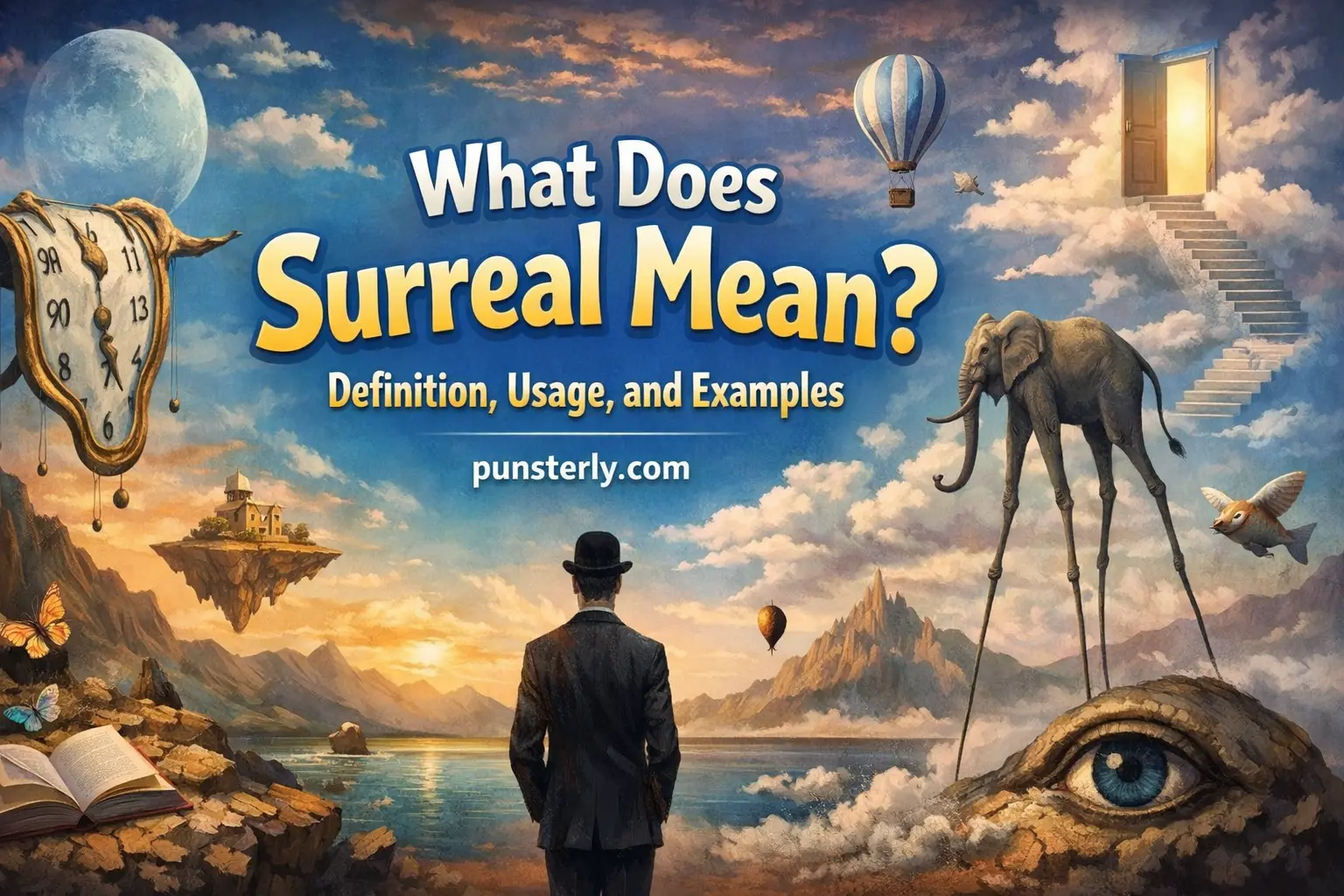
People often see surreal in books, movie reviews, news stories, and daily conversation. It usually appears when someone wants to describe a moment that feels strange, dreamlike, or hard to believe.
This word matters because it adds a specific feeling. It does not just mean “odd.” It suggests that something feels real and unreal at the same time.
This guide explains the plain meaning, pronunciation, grammar role, common contexts, and best examples. It also shows when surreal fits well and when another word works better.
Quick Answer
What does surreal mean? Surreal usually means very strange, dreamlike, or oddly unreal. It is most often used as an adjective for experiences, images, scenes, or feelings.
TL;DR
• Surreal usually means dreamlike or strangely unreal.
• It is mainly used as an adjective.
• It is not mainly a slang word.
• It often describes real events that feel unbelievable.
• It can also relate to art and writing.
• Tone depends on context, not the word alone.
Definition in Plain English
In plain English, surreal describes something that feels so strange that it seems like a dream. The thing may be real, but it does not feel fully real in the moment.
For example, winning an award, seeing a silent city street after a storm, or meeting a famous person might feel surreal. The event happened, but it feels oddly unreal.
A simple way to remember it is this: surreal means “real, but strangely dreamlike.”
Part of Speech: Is Surreal a Noun, Verb, or Adjective?
Surreal is mainly an adjective. It describes a noun, such as an experience, image, scene, or moment.
Examples:
• a surreal painting
• a surreal dream
• a surreal experience
• a surreal silence
It is not commonly used as a noun or verb. You would not normally say “I surrealed” or “that was a surreal.”
A related noun is surreality, but that form is much less common in everyday writing.
How to Pronounce Surreal
A simple pronunciation guide is:
• US: suh-REE-uhl
• UK: suh-REE-uhl or suh-RIH-uhl
The stress usually falls on the second part. Many learners say it smoothly in three beats: suh-REE-uhl.
A common mistake is saying it too flat or too fast. Slowing down helps the word sound natural.
How People Use Surreal in Real Life
People often use surreal for moments that feel hard to process. The event is real, but it feels dreamlike, shocking, or oddly distant.
You may hear it after major life changes. Someone might say, “Graduation felt surreal,” or “It was surreal seeing my childhood home again.”
The word can fit happy, sad, or unsettling moments. The context decides the tone.
What Surreal Means in Art and Writing
In art and writing, surreal can describe images or scenes that mix reality with dreamlike details. This use connects to Surrealism, an art and literary movement.
For example, a painting with melting objects or impossible landscapes may feel surreal. A story may also feel surreal if normal life suddenly turns strange in a dreamlike way.
In everyday speech, people do not need to mean the art movement exactly. They often just mean “strangely unreal.”
Surreal vs. Unreal vs. Weird
These words overlap, but they are not exact matches. Surreal usually has a dreamlike quality that weird and unreal do not always carry.
| Context | Best Choice | Why |
| A shocking moment that feels dreamlike | Surreal | Suggests real life feels strangely unreal |
| Something impossible or not true | Unreal | Focuses on not being real |
| Something odd or unusual | Weird | Simpler and broader everyday choice |
Use surreal when you want that mix of reality, surprise, and dreamlike feeling.
Synonyms and Antonyms of Surreal
Close synonyms include:
• dreamlike
• unreal
• bizarre
• strange
• otherworldly
These are not always perfect swaps. Dreamlike is often the closest in feeling. Bizarre can sound stronger or more unsettling.
Context-based opposites include:
• ordinary
• realistic
• normal
• familiar
There is no single perfect opposite in every sentence. The best opposite depends on the context.
When to Use Surreal and When Not to Use It
Use surreal when something feels unusually dreamlike or emotionally hard to believe. It works well for strong moments and vivid descriptions.
Do not use it for every small surprise. If your coffee order changed, surreal may sound exaggerated.
A good test is simple: if the moment feels almost dreamlike, the word may fit. If it is only mildly odd, choose strange or unexpected instead.
Common Mistakes With Surreal
One mistake is using surreal as if it only belongs in art talk. It also works in normal life.
Another mistake is treating it like a slang term only. People do use it casually, but it is a standard English adjective.
A third mistake is overusing it for small events. The word sounds strongest when the moment truly feels unusual or dreamlike.
Example Sentences With Surreal
Here are some natural examples:
• Standing on stage felt surreal.
• The empty airport looked surreal at sunrise.
• The film creates a surreal world of silence and color.
• Seeing my old school again was surreal.
• The whole moment felt surreal, like a dream.
Notice how the word often appears with felt, looked, or seemed. That pattern is very common.
Origin of the Word Surreal
The word surreal is linked to surrealism. In English, it appears as a later form built from that older art term.
Its history points to dreamlike, unusual, and non-rational imagery. That is why the modern meaning still carries a strong sense of unreality and strange contrast.
The exact history is usually explained briefly, and that is enough for most readers. In daily use, the main thing that matters is how the word feels in context.
Mini Quiz
- What part of speech is surreal most commonly?
- Does surreal usually describe something ordinary or dreamlike?
- Which fits better: “a surreal experience” or “a surreal chair” in most cases?
- Is surreal only used for art?
Answer key
- Adjective
- Dreamlike
- “A surreal experience”
- No, it is also used in everyday English
FAQ
Does surreal mean fake?
Not exactly. Something surreal can be real. It just feels strangely unreal or dreamlike.
Is surreal a positive or negative word?
It can be either. It often carries surprise or emotional intensity, but the context decides whether it feels good, bad, or neutral.
Is surreal a slang word?
No. Surreal is a standard English adjective. People may use it casually, but it is not mainly slang.
Can surreal describe a real event?
Yes. That is one of its most common uses. People often use it for real events that feel hard to believe.
What does surreal mean in art?
In art, surreal often describes dreamlike images, strange combinations, or scenes that feel beyond normal reality. This sense connects to Surrealism.
What is the difference between surreal and weird?
Weird is broader and more casual. Surreal adds a dreamlike or unreal feeling.
Conclusion
Now you know what surreal means and how it works in real English.
When a moment feels real but strangely dreamlike, surreal is often the right word.
The next time you see it, try checking the feeling around it. That usually reveals the meaning fast.
