
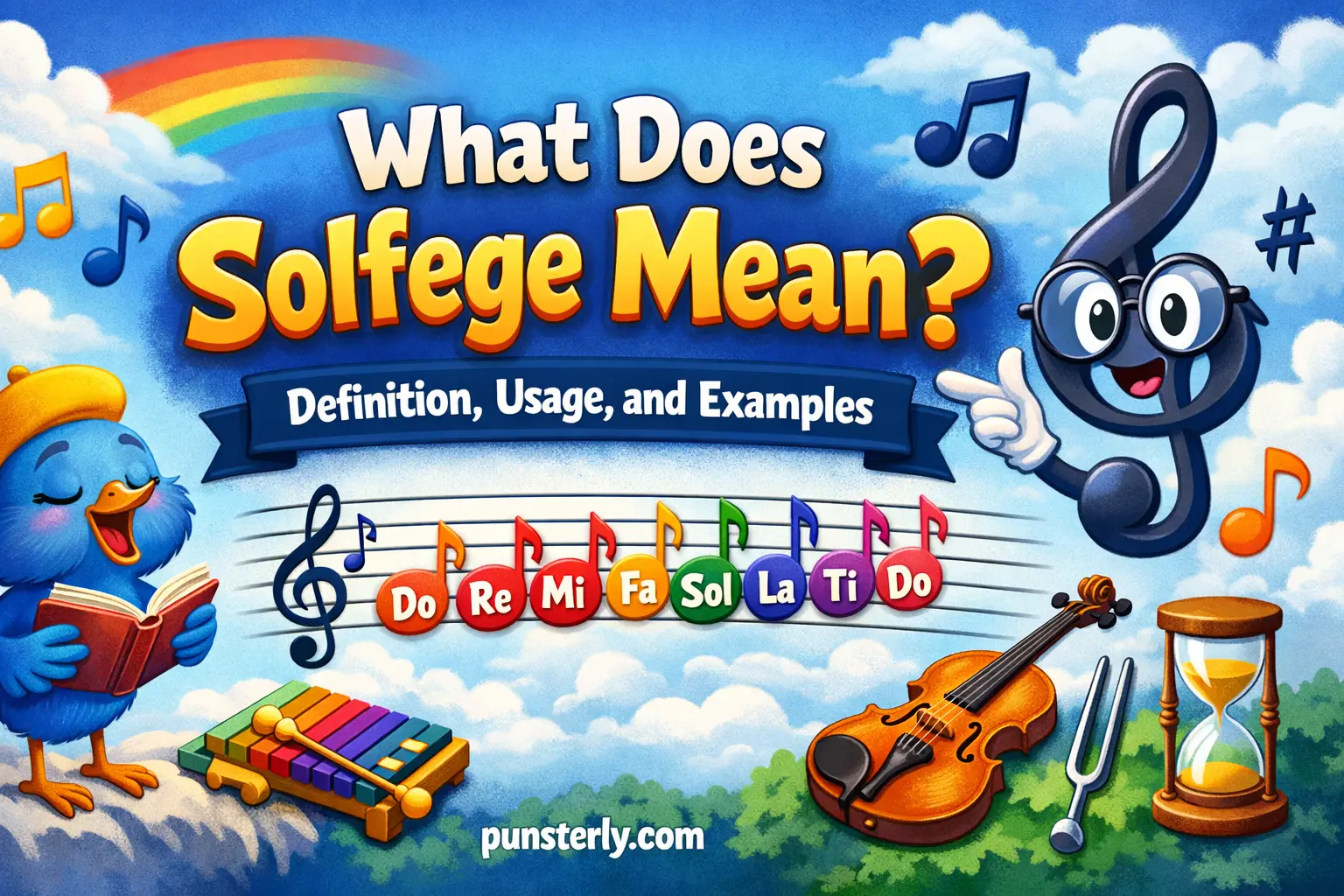
If you study music, choir, singing, or piano, you may see the word solfege. It can look unfamiliar at first, especially if you only know note names like C, D, E, F, G, A, and B. That is why many beginners search for what it means before they can follow a lesson.
This article explains solfege in plain English. You will learn what the word means, how people pronounce it, how it works, and where it is used. You will also see simple examples, the difference between fixed do and movable do, and a few common mistakes to avoid.
QUICK ANSWER
What does solfege mean? Solfege is a music system that uses syllables like do, re, mi, fa, sol, la, and ti to help people sing, hear, and read notes more easily. The word can also refer to singing exercises that use those syllables.
TL;DR
• Solfege is a music term, not everyday slang.
• It uses syllables like do, re, mi, and fa.
• It helps with singing, pitch, and note reading.
• The word is usually a noun.
• It can mean a system or an exercise.
• Fixed do and movable do are two common approaches.
What Solfege Means in Plain English
Solfege is a way to name and sing notes with easy syllables. Instead of saying letter names, people sing do, re, mi, fa, sol, la, ti.
In simple terms, it helps musicians hear how notes move. It also makes scales and melodies easier to practice.
Is Solfege a Word or a Music Method?
It is both a word and the name of a music method. When someone says, “We practiced solfege today,” they usually mean they used those note syllables in class.
The word can also mean a singing exercise. In that sense, a teacher may assign short patterns or scales for practice.
How Solfege Works
Solfege matches a syllable to each note in a scale. That gives singers a simple sound for each step.
For example, in a basic major scale, the pattern is:
• do
• re
• mi
• fa
• sol
• la
• ti
• do
When people sing a melody with these syllables, they can focus on pitch movement more clearly.
The Basic Solfege Syllables
The most common set is:
• do
• re
• mi
• fa
• sol
• la
• ti
Many people learn these from the song “Do-Re-Mi.” That song is helpful, but solfege is more than a song. It is a real music-learning system.
A common mistake is thinking the syllables are random sounds. They are not. Each one stands for a place in the scale.
Fixed Do vs. Movable Do
There are two main ways people use solfege. The difference matters in music classes.
| Context | Best Choice | Why |
| Learning note relationships in a key | Movable do | It shows how each note functions in the scale |
| Learning notes as fixed pitch names | Fixed do | It keeps the same syllable for the same pitch |
In movable do, the first note of the scale is always do. So if the key changes, do changes too.
In fixed do, do stays the same pitch. In that system, do is always C.
A simple correction helps here: do not say one system is always “right.” Different schools and teachers prefer different methods.
How to Pronounce Solfege
A simple guide is: sol-FEZH.
The last sound is not a hard “g.” It sounds more like the ending of “beige” for many English speakers.
Some people also see the accented spelling solfège. It means the same thing. The accent is common in French-style spelling.
Part of Speech and Related Forms
Solfege is usually a noun.
Examples:
• “Solfege helps beginners hear pitch patterns.”
• “Our choir class starts with solfege.”
You may also see related forms:
• solfège — accented spelling
• solfeggio — related variant form
• solmization — a broader term for naming notes with syllables
For most beginners, solfege is the clearest everyday choice in English.
Where You Might See or Hear the Term
You will often hear this word in places like:
• choir rehearsal
• voice lessons
• piano lessons
• music theory classes
• ear-training practice
• sight-singing exercises
Outside music, most people do not use the word often. That makes it a context-specific term.
How to Use Solfege in a Sentence
Here are a few natural examples:
• “My teacher used solfege to help us sing the scale.”
• “We practiced the melody in solfege before singing the words.”
• “Solfege made it easier to hear the note changes.”
• “Some classes teach fixed do, while others teach movable do.”
A common mistake is writing, “Solfege means do re mi only.” A better sentence is, “Solfege is a system that uses do re mi and the other scale syllables.”
Common Mistakes and Easy Corrections
Some beginners confuse the word with just one song. That is too narrow. Solfege is a full method, not only a tune from a movie.
Some people think it is a letter-note system. It is not. Letter notes and solfege are related, but they are not the same naming style.
Others mix up solfege and solmization. Solmization is the broader idea. Solfege is one well-known form of it.
Origin and History in Brief
The history begins in medieval music teaching. A system of note syllables grew from older teaching practice connected to ut, re, mi, fa, sol, la.
Later, the system changed over time. The older ut form gave way to do, and a seventh syllable was added in later practice.
For most readers, the main point is simple: solfege has old roots, but it is still used in modern music learning.
Related Terms, Synonyms, and Antonyms
Close or related terms include:
• solfège — same word, accented spelling
• solfeggio — related variant form
• solmization — broader technical term
• sight-singing — related practice, but not the same thing
There is no perfect everyday antonym for solfege. It names a specific music system, so an opposite word does not neatly fit.
Mini Quiz
- Is solfege mainly a music term or a slang term?
- What syllable usually starts the common major-scale pattern?
- In movable do, does do stay on the same pitch in every key?
- Is solfege usually a noun or a verb?
Answer key:
• 1: A music term
• 2: Do
• 3: No
• 4: Noun
FAQ
What does solfege mean in music?
In music, solfege means a system that uses syllables like do, re, mi, fa, sol, la, and ti. These syllables help singers and students hear, sing, and read note patterns more easily.
Is solfege the same as do re mi?
Not exactly. Do re mi are part of solfege, but solfege is the larger system. It includes the full set of syllables and the way musicians use them.
How do you pronounce solfege?
Most English speakers say it like sol-FEZH. The ending usually sounds soft, not like a hard “g.”
What is the difference between fixed do and movable do?
In fixed do, do stays the same pitch. In movable do, do changes with the key and marks the first note of the scale.
Is solfege still used today?
Yes. It is still common in choir, singing, ear-training, and beginner music lessons. Many teachers use it because it helps students hear patterns clearly.
Where did solfege come from?
It comes from older European music teaching. The system developed from earlier note syllables and later changed into the form many learners know today.
Conclusion
Now you know what does solfege mean and why it matters in music study. It is a simple but useful way to hear, sing, and understand note patterns.
The next good step is to try singing one major scale with do, re, mi, fa, sol, la, ti, do.
