
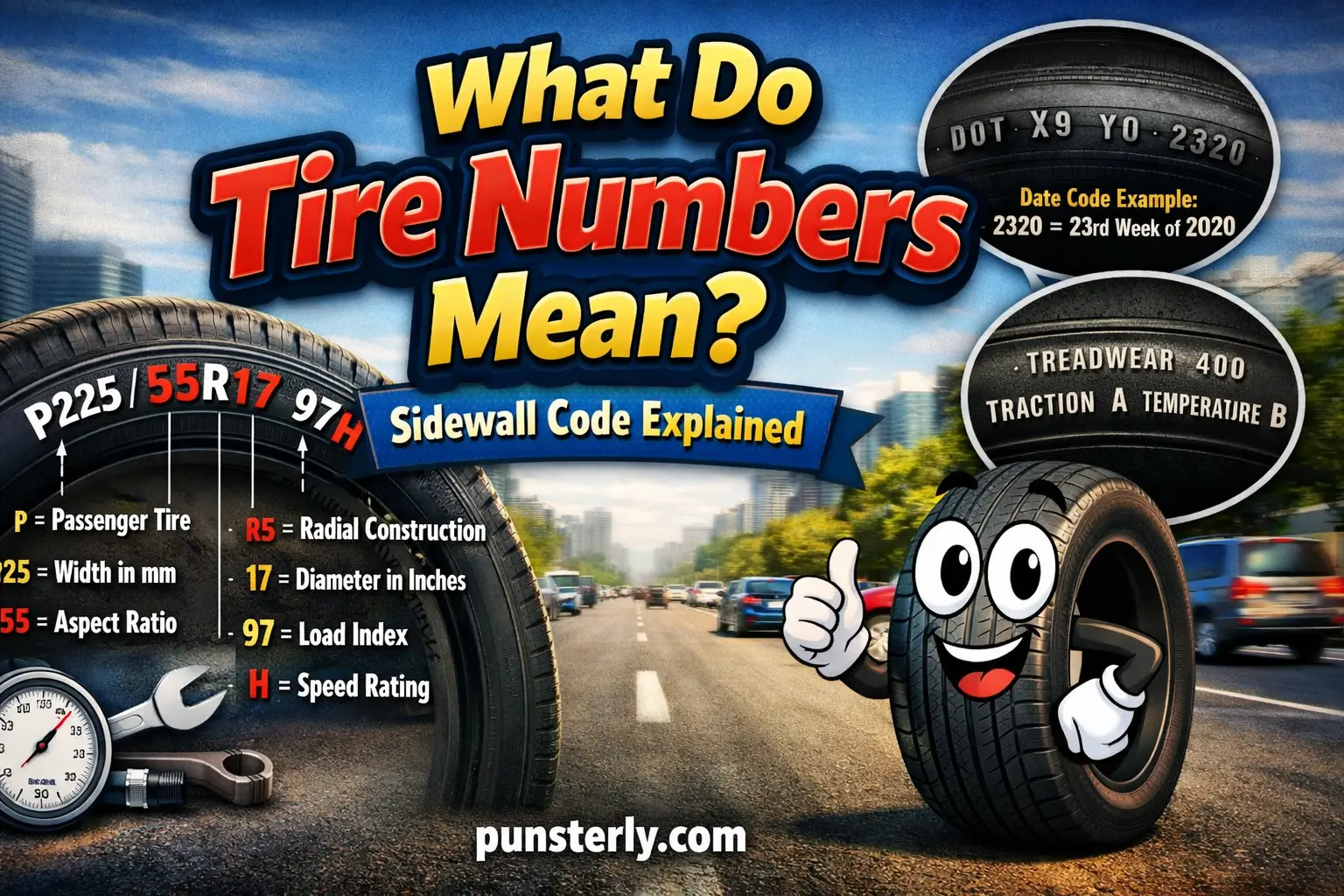
If you have ever looked at a tire sidewall, you have probably seen a long string of letters and numbers that feels hard to decode. It may look random at first, but each part tells you something useful. These markings can show the tire’s type, width, sidewall height, wheel size, load limit, speed category, and even its build date.
That matters when you buy replacement tires, compare options, or simply want to know what is already on your car. A small mistake can lead to the wrong fit or the wrong load rating. This guide explains what tire numbers mean in plain English, how to read them step by step, and which markings matter most for everyday drivers.
QUICK ANSWER
What do tire numbers mean? They are a code on the tire sidewall that tells you the tire’s size, type, construction, load capacity, speed category, and other key details.
A code like P215/65R15 95H is not one big number. It is several small labels packed into one line.
TL;DR
• Tire numbers mostly describe size, type, and limits.
• Width is usually shown in millimeters.
• Aspect ratio shows sidewall height by percentage.
• Rim diameter is usually listed in inches.
• Load and speed marks matter for safe replacement.
• DOT numbers show when the tire was made.
Why tire numbers matter
Tire numbers are not there for decoration. They help match the tire to the vehicle, wheel, and intended use.
They also help you avoid buying a tire that is the wrong size or has the wrong load support. Even when two tires look similar, their sidewall codes can point to important differences.
How to read a common tire code
A common example is:
P215/65R15 95H
Here is the simple breakdown:
• P = passenger tire
• 215 = tire width in millimeters
• 65 = aspect ratio, or sidewall height as a percent of width
• R = radial construction
• 15 = wheel diameter in inches
• 95 = load index
• H = speed rating
This code is a practical label, not a word or phrase in normal grammar. It works as a technical identifier.
What the first letter means
The first letter, if there is one, tells you the tire type or intended use.
Common examples include:
• P = passenger vehicle
• LT = light truck
• ST = special trailer
• T = temporary spare
Sometimes there is no starting letter. In many cases, that points to a metric tire format rather than a P-metric one.
A common mistake is assuming the first letter is a brand code. It is not. It usually describes the tire category.
What the three main size numbers mean
The three size numbers are the ones most drivers notice first. They usually tell you width, sidewall shape, and wheel size.
Width
The first main number is the tire width in millimeters. In 215/65R15, the 215 means the tire is about 215 millimeters wide from sidewall to sidewall.
Aspect ratio
The second number comes after the slash. In 215/65R15, the 65 means the sidewall height is 65% of the tire’s width.
A lower number usually means a shorter sidewall. A higher number usually means a taller sidewall.
Rim diameter
The last main size number is the wheel diameter in inches. In 215/65R15, the 15 means the tire fits a 15-inch wheel.
A common mistake is calling this the tire’s full diameter. It is the wheel diameter, not the total height of the mounted tire.
What the construction letter means
The letter in the middle tells you how the tire was built.
Most modern passenger tires use:
• R = radial
You may also see older or less common construction marks such as:
• B = belted bias
• D = diagonal or bias
For most everyday drivers, R is the one you will see most often.
What load index and speed rating mean
After the size code, you will often see a number and a letter together. This pair is often called the service description.
In 95H:
• 95 = load index
• H = speed rating
Load index
The load index is a code for how much weight one tire can carry when properly inflated. It is not written in plain pounds right inside the size code, so you usually need a chart to convert the number.
The main point is simple: do not replace a tire with one that has a lower required load index.
Speed rating
The speed rating is a letter that shows the tire’s tested speed category under set conditions. It is not a suggestion to drive that fast.
It also does not mean “best tire.” It is just one performance mark among several.
Small comparison table
| Context | Best Choice | Why |
| Replacing one everyday passenger tire | Match size and meet or exceed load and speed marks | Helps preserve proper fit and intended support |
| Unsure which rating to trust | Use the vehicle placard or owner’s manual | That is the vehicle-specific reference |
| Same size, different service description | Choose the one that meets vehicle requirements | Same size alone is not enough |
What the DOT code and date code mean
Elsewhere on the sidewall, you will see DOT followed by a longer string. This is the tire identification code.
The part most drivers care about is the date code at the end. On modern tires, the last four digits show:
• first two digits = week
• last two digits = year
Example:
• 1324 = the 13th week of 2024
This is useful when checking tire age. It is also helpful during recalls or replacement planning.
What MAX LOAD, MAX PRESS, XL, HL, and UTQG mean
These marks are important, but many people read them the wrong way.
MAX LOAD
This tells you the maximum load the tire is designed to carry under stated conditions. It is not the same as your vehicle’s total payload sticker.
MAX PRESS
This is the tire’s maximum inflation figure shown on the sidewall. It is not usually the everyday pressure you should set for normal driving.
For normal use, check the sticker on the driver’s door jamb or your owner’s manual.
XL and HL
You may see load-related labels such as:
• XL = extra load
• HL = higher load
These indicate tires built to support more load than a standard tire of the same size class. They matter when replacing tires on vehicles that require them.
UTQG
UTQG stands for a grading system often shown on passenger tires. It can include:
• treadwear
• traction
• temperature
This helps compare some passenger tires, but it is not the whole story of tire quality.
Other symbols you may see
Not every sidewall mark is part of the main size code.
Some common extras include:
• M+S = mud and snow
• 3PMSF = three-peak mountain snowflake
• TUBELESS = no inner tube needed
• brand and tire line name
• OE marks for factory-approved fitments
The winter symbols matter because M+S and 3PMSF are not the same thing. The snowflake mark points to a more specific winter-performance standard.
When buying replacements, which numbers must match
Not every mark has to match in the exact same way, but some are especially important.
Start with these:
• tire size
• wheel diameter
• load requirement
• speed requirement
• special type requirements such as XL, HL, LT, or run-flat if your vehicle calls for them
If you are unsure, use the door-jamb placard and owner’s manual first. The sidewall helps you read what is currently installed, but the vehicle information helps confirm what should be installed.
Common mistakes when reading tire numbers
A few mistakes happen again and again.
• Thinking the sidewall PSI is the normal fill target
• Matching the size but ignoring load index
• Matching the size but ignoring speed rating
• Confusing wheel diameter with full tire height
• Assuming every tire with the same size code is fully interchangeable
• Reading only one sidewall and missing the full DOT date code
The fix is simple: read the full sidewall, then compare it with the vehicle placard.
Examples of tire numbers in real life
Here are a few common patterns.
Passenger tire
P215/65R15 95H
This is a common passenger-car format. It tells you the basic size plus the service description.
Light-truck tire
LT265/70R17
This starts with LT, so it is built for light-truck use. It may also include load range or other truck-specific markings.
Temporary spare
T135/80D16
The T shows a temporary spare type. These are not meant for normal long-term driving.
Inch-style light-truck format
You may also see an off-road or truck format like:
35×12.50R17LT
In that style, the order and units look different. The first number usually refers to overall tire height in inches, followed by width, then wheel diameter.
Related terms, close matches, and common confusion
A few terms sound similar but mean different things.
Tire size vs wheel size
Tire size includes more than the wheel size. The wheel size is only one part of the full code.
Load index vs max load
The load index is a coded number. Max load is usually printed elsewhere in plain wording.
Speed rating vs speed limit
The speed rating is a tire category mark. It is not a road-use recommendation.
Synonyms and antonyms
There is no perfect one-word synonym for “tire numbers.” Close matches include:
• tire code
• sidewall code
• tire markings
• tire size code
A true antonym does not really fit here, because this is a label system, not a word with a direct opposite.
Mini quiz
Try these quick questions.
- In P215/65R15, what does 215 mean?
- In 95H, which part shows load?
- Does the sidewall max PSI usually equal your normal fill pressure?
- What do the last four digits of the DOT date code show?
- If two tires share the same size, can their load ratings still differ?
Answer key
- Tire width in millimeters
- The number 95
- No
- Week and year of manufacture
- Yes
FAQs
What do the three numbers on a tire mean?
They usually point to width, aspect ratio, and wheel diameter. For example, in 215/65R15, the tire is 215 mm wide, the sidewall height is 65% of that width, and the wheel diameter is 15 inches.
How do I read the numbers and letters on a tire sidewall?
Read the code in sections, not all at once. Start with tire type, then width, aspect ratio, construction, wheel diameter, load index, and speed rating.
Can tires with the same size have different load or speed ratings?
Yes. Two tires can share the same basic size but still differ in load index or speed rating. That is why the full code matters.
What does the DOT number on a tire mean?
The DOT code identifies the tire and includes its manufacture date. The last four digits on modern tires show the week and year it was made.
Is the PSI on the tire the pressure I should use?
Usually, no. The sidewall figure is commonly the tire’s maximum pressure marking, not the normal everyday target for your vehicle.
What does M+S mean on a tire?
M+S means mud and snow. It is a sidewall marking used for certain all-season or winter-oriented tread designs.
What is the difference between M+S and 3PMSF?
M+S is a general marking. 3PMSF, the snowflake-on-mountain symbol, points to a more specific severe-snow performance standard.
Conclusion
Now you know what do tire numbers mean and how to read them without guessing.
The next time you check a sidewall, read the code in parts. That makes choosing, comparing, and replacing tires much easier.
